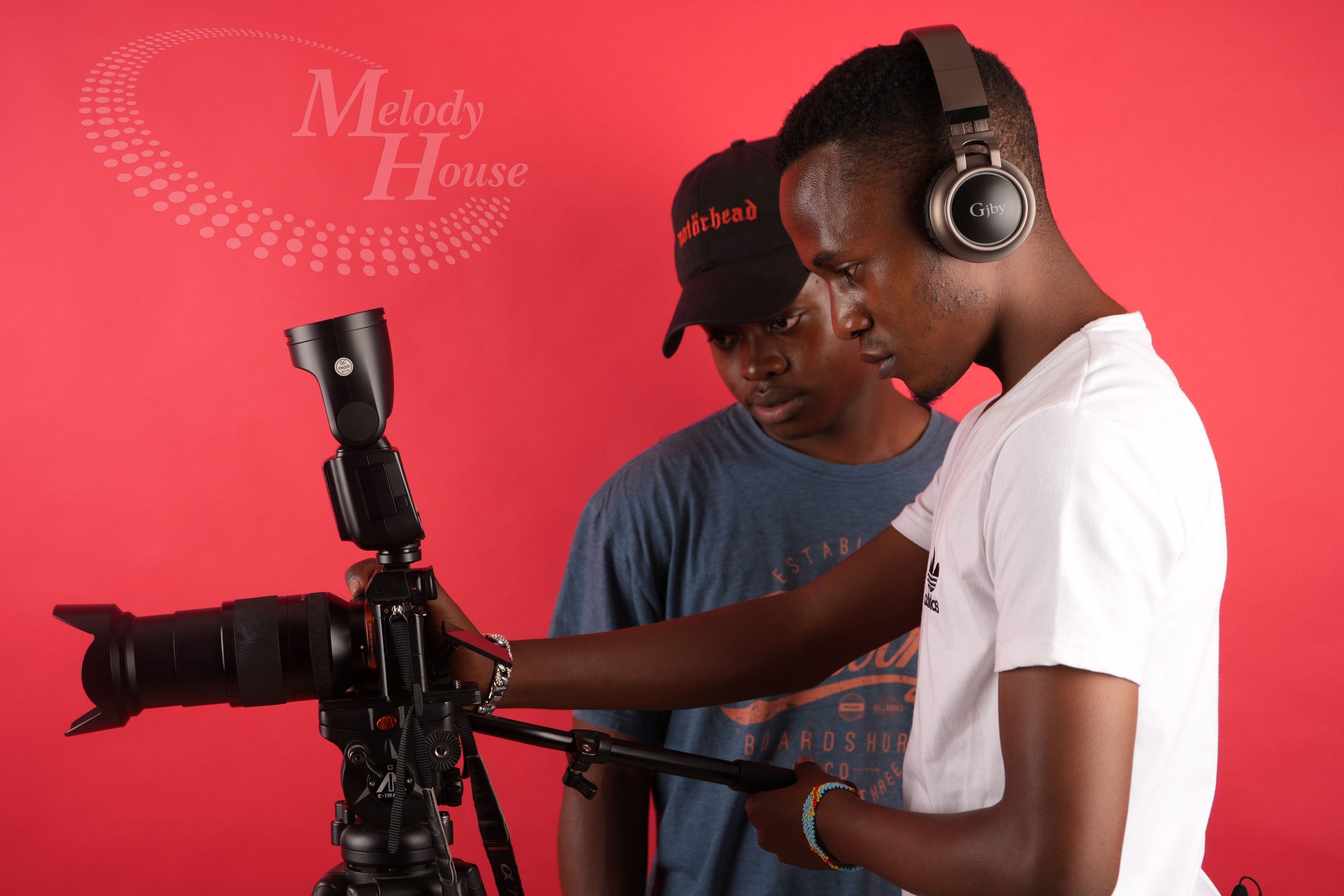
Videography Courses In Kenya | Best Video Production Course 2026
In a digital era where visual content is the primary currency, the ability to create high-quality video is no longer just a hobby—it’s a high-demand professional skill. The ability to create compelling visual content is essential for storytelling and professional success in today’s creative industries. Whether you are an aspiring filmmaker, a content creator, or a marketing professional, here is why our videography courses at Melody House stands out among the top videography courses in Kenya.
Why Choose Our Videography Courses in Kenya?
1. Master the Full Production Lifecycle
Unlike a standard video editing course that only teaches you how to cut clips, our curriculum offers a holistic approach. We believe that a great editor must understand how a shot was lit, and a great cinematographer must understand how their footage will be stitched together. By enrolling in our video production and editing courses, you gain a 360-degree understanding of the craft, from the first spark of an idea to the final color grade.
2. Industry-Standard Training
If you are searching for comprehensive videography courses in Kenya, you’ll find that our syllabus is built on international standards. The training also encompasses key aspects of filmmaking, preparing students for roles in both videography and film production. We move beyond “basic recording” to teach you the “why” behind the “how.” From mastering the exposure triangle to executing complex drone maneuvers, our videography course ensures you are ready for a professional film set on day one.
3. State-of-the-Art Equipment & Tech
The gap between amateur and professional work often lies in the gear and the technique. Our videography courses provide hands-on access to: 4K Cinema Cameras and high-speed optics; Industry-leading stabilizers and gimbals; Advanced sound recording suites; and the latest NLE (Non-Linear Editing) software used in Hollywood.
4. A Portfolio-Driven Approach
Most videography schools in Kenya focus on theory; we focus on the reel. Every module in our video production course is designed to produce a tangible asset for your portfolio. By the time you graduate, you won’t just have a certificate; you’ll have a professional-grade demo reel that proves your value to clients and agencies.
5. Specialized Local Expertise
We understand the unique landscape of the creative industry in East Africa. Our videography course includes modules on navigating the local market, legal requirements for filming, and networking within the vibrant Kenyan creative community.
6. Career-Ready Skills
From corporate documentaries and music videos to social media content and live events, our video production and editing courses prepare you for a diverse range of career paths. We don’t just teach you how to use a camera; we teach you how to build a career.
7. Expert Faculty & Real-World Experience
At Melody House, our strength lies in the expertise and dedication of our faculty and instructors. Each member of our teaching team is a seasoned professional in modern video production, digital marketing, and film production, bringing years of real-world experience to the classroom. Their mission is to equip students with the essential skills and technical know-how needed for a successful career in today’s fast-evolving media landscape.
Our instructors are accomplished videographers, filmmakers, and content creators who have worked on a diverse range of projects—from social media content and digital marketing campaigns to feature films and television productions. They are passionate about sharing their knowledge of videography basics, camera operation, lighting techniques, and post production workflows, ensuring that every student gains both theoretical knowledge and practical experience.
8. Hands-On Philosophy & Mentorship
Hands-on training is at the heart of our teaching philosophy. Our faculty guide students through every stage of the creative process, from mastering industry standard equipment to developing advanced techniques in color grading, sound recording, and visual effects. With deep expertise in editing software such as Adobe Premiere Pro and Final Cut Pro, our instructors help students edit videos to a professional standard, preparing them for the demands of content creation across digital platforms.
Mentorship is a key part of our comprehensive program. Our instructors are committed to nurturing creativity, critical thinking, and professional development, helping aspiring filmmakers and videographers build a standout professional portfolio. They provide personalized feedback and support, encouraging students to push their creative boundaries and develop their unique visual storytelling style.
9. Industry Connections & Career Success
Beyond the classroom, our faculty maintain strong connections with media houses and production companies in Nairobi, Kenya, and beyond. These industry links open doors to valuable job opportunities and internships, giving our graduates a competitive edge in the job market. Whether you are pursuing a certificate or diploma program, our expert faculty are dedicated to your growth and success, ensuring you are fully prepared for a rewarding career in video production, digital marketing, and beyond.
By learning from our experienced instructors, you will gain the technical skills, creative confidence, and industry insights needed to thrive in the world of film, videography, and media. Our faculty’s commitment to excellence and hands-on training is what sets Melody House apart as a leader in videography training in Kenya.
Summary of Benefits:
- Expert Instruction: Learn from seasoned cinematographers and editors.
- Comprehensive Curriculum: The most detailed videography course covering both Basic and Advanced levels.
- Networking: Join a community of creators and potential collaborators.
Our Videography Course Curriculum
Videography is the intersection of technical precision and artistic intuition. This course is designed to equip participants with both technical and creative skills required for modern video production. The course is structured into two distinct levels: Level 1 (Basic Videography Course) focuses on the “Science of Capturing,” while Level 2 (Advanced Videography Course) focuses on the “Art of Storytelling.” By the end of this program, students will transition from hobbyists to professional-grade image makers capable of handling commercial, documentary, and narrative workflows.
Level 1: Basic Videography Course– The Technical Foundation
Module 1: The Physics of the Camera and Exposure
In this module, students move beyond “Auto Mode.” We break down the camera into its component parts to understand how light becomes data.
- The Exposure Triangle: A deep dive into Aperture (f-stops) and its effect on depth of field; Shutter Speed and the “180-degree rule” for cinematic motion blur; and ISO/Gain and its relationship to digital noise.
- Sensor Science: Understanding how light hits the CMOS sensor. Differences between Full Frame (shallow DoF, better low light) and Crop Sensors (APS-C, MFT).
- Lens Optics: The difference between spherical and anamorphic glass. Understanding focal lengths: Wide (distortion), Normal (human eye perspective), and Telephoto (compression).
- Assignment: The “Manual Challenge.” Students must shoot three clips of the same subject—one overexposed, one underexposed, and one perfectly balanced—using only manual adjustments.
Module 2: Visual Grammar and Composition
If exposure is the “ink,” composition is the “syntax.” This module teaches students how to guide the viewer’s eye.
- The Rule of Thirds and Beyond: Utilizing the Golden Ratio and Fibonacci spirals for more organic framing.
- Dynamic Symmetry: Creating tension and balance using diagonal lines and geometric shapes within the frame.
- The Psychology of Shot Sizes: When to use a Close-Up (to convey emotion) versus a Wide Shot (to establish context).
- Angle of View: How low angles create power and high angles create vulnerability.
- Assignment: The “Silent Story.” Create a 60-second sequence using only 5 static shots that tells a narrative without moving the camera.
Module 3: Essential Lighting Theory
Lighting is not just about making things visible; it is about creating dimension.
- The 3-Point System: A mastery of the Key Light (primary source), Fill Light (shadow management), and Back Light (subject separation).
- Quality of Light: Hard light vs. Soft light. Understanding the Inverse Square Law—how distance from the light source affects intensity and fall-off.
- Color Temperature: Mastering the Kelvin scale. Understanding how to balance 3200K (Tungsten) with 5600K (Daylight) using gels or internal white balance.
- Grip Basics: Introduction to “C-Stands,” flags, and silks to shape and “cut” light.
Module 4: The Art of Field Audio
Audio is 50% of the viewing experience. Poor video can be “stylistic,” but poor audio is unwatchable.
- Microphone Physics: Understanding polar patterns—Cardioid, Super-cardioid (Shotgun), and Omnidirectional.
- Signal Flow: XLR vs. 3.5mm; Line level vs. Mic level.
- Field Recording: Techniques for hiding lavalier mics on talent and the proper “boom” technique to get the mic close without entering the frame.
- Monitoring: Learning to read Peak meters vs. RMS and identifying “room tone.”
Module 5: Basic Post-Production Workflow
- Non-Linear Editing (NLE): Introduction to the interface of Premiere Pro or DaVinci Resolve.
- File Management: The importance of “Scratch Disks” and organized folder structures.
- The Edit: Understanding “The Cut,” “The Dissolve,” and “The Wipe.” Introduction to the concept of “Pacing.”
- Delivery: Understanding codecs (H.264, ProRes) and wrappers (.mp4, .mov) for YouTube vs. Broadcast.
Level 2: Advanced Videography Course – Narrative & Cinematic Artistry
Module 6: Advanced Optics and Specialized Movement
Level 2 begins with mastering the “physics of emotion” through movement.
- Motivated Movement: Every move must have a reason. We study the “Push-In” for realization and the “Slow Pull-Back” for isolation.
- Gimbal and Steadicam Mastery: Techniques for smooth tracking shots, focusing on the “Ninja Walk” and balancing high-payload rigs.
- The Parallax Effect: Using sliders to create depth by moving the foreground against the background.
- Deep Focus vs. Selective Focus: Mastering the follow-focus system for complex “rack focus” transitions.
Module 7: Cinematic Lighting and High-Dynamic Range (HDR)
Moving beyond basic illumination into “painting with light.”
- Low-Key Lighting: Using high contrast ratios (Chiaroscuro) to create drama and mystery.
- Practical Lighting: Using lights found in the scene (lamps, neon signs) as the primary sources, supplemented by “invisible” film lights.
- Shooting in LOG/RAW: Understanding Gamma curves (S-Log, V-Log). Learning how to expose “to the right” (ETTR).
- Advanced Color Grading: Using Power Windows and Qualifiers in DaVinci Resolve to isolate and change specific colors.
Module 8: Visual Storytelling and Continuity
This module bridges the gap between a “cameraman” and a “cinematographer.”
- The 180-Degree Rule and its Subversion: When and how to break the “axis of action” for psychological effect.
- Continuity of Action: Ensuring lighting, wardrobe, and actor positions match across multiple takes.
- The Kuleshov Effect: The theory that two shots joined together create a third meaning in the viewer’s mind.
- Montage Theory: Using fast-paced editing to compress time or convey a mental state.
Module 9: Drone Cinematography and Aerial Arts
Adding the “bird’s eye view” to your storytelling toolkit.
- Aviation Regulations: Understanding FAA Part 107 (or local equivalent) and No-Fly Zones.
- Aerial Movements: Mastering the “Orbit,” the “Bird’s Eye,” and the “Dronie.”
- Safe Operation: Pre-flight checklists, signal interference, and emergency return-to-home protocols.
- Integrating Aerials: How to use drone shots as establishing shots without making the video feel like a real estate ad.
Module 10: Multi-Camera and Live Production
Transitioning from single-camera narrative to high-pressure live environments.
- The Switcher Interface: Introduction to Blackmagic ATEM or vMix for live switching.
- Tally and Comms: The logistics of directing a crew of camera operators simultaneously.
- Syncing Audio/Video: Using Timecode Generators (like Tentacle Sync) to ensure frame-accurate alignment in post-production.
- Live Color Grading: Using LUTs in-camera to ensure all angles match during a live broadcast.
Module 11: Production Management and The Business of Video
- Pre-Visualization: Creating storyboards and overhead lighting maps.
- Location Scouting: Analyzing power requirements and acoustic interference.
- Directing Talent: Developing a shorthand with actors to elicit authentic performances.
- Contracts and Licensing: Understanding Intellectual Property and Music Licensing.
Module 12: Advanced Sound Design and Foley
Sound is used to build a world that doesn’t exist on screen.
- Soundscapes: Layering ambient sounds (birds, traffic) to create a “sense of place.”
- Foley Artistry: Recording custom sound effects (footsteps, clothing rustle) for tactile realism.
- Subliminal Audio: Using low-frequency “drones” for tension.
- The Final Mix: Leveling dialogue and music to professional LUFS standards.
To graduate, the student must produce a 3-minute cinematic short.
- Pre-Production: Submit a script, storyboard, and equipment list.
- Production: Execute the shoot, acting as Director and DP.
- Post-Production: Complete a full edit including color grade and sound design.
- Critique: A “Screening Room” session where the work is critiqued by peers.
Summary of Key Differences
| Skill | Basic Level | Advanced Level |
|---|---|---|
| Focus | Technical Accuracy | Emotional Impact |
| Motion | Fixed / Handheld | Gimbal / Drone / Slider |
| Light | Visibility | Texture & Mood |
| Audio | Clean Dialogue | Immersive Soundscapes |
| Edit | Continuity | Narrative Rhythm |
Appendix: Essential Gear List
Basic Level Student Kit
- Camera: Mirrorless body (e.g., Sony Alpha, Canon R, or Fujifilm X series) capable of 4K/24fps.
- Lens: 50mm Prime (the “Nifty Fifty”) for learning depth of field.
- Audio: On-camera shotgun mic and a basic external recorder.
- Support: Sturdy tripod with a fluid head.
Advanced Level Professional Kit
- Camera: Cinema-grade body with 10-bit 4:2:2 internal recording and XLR inputs.
- Lens: A set of prime lenses (24mm, 35mm, 85mm) for consistent look.
- Grip: C-Stands, sandbags, and a 5-in-1 reflector kit.
- Monitor: A 7-inch bright monitor with waveform and false color tools.
Note to Students: While the school provides cinema-grade gear during lab hours, having your own basic kit is highly recommended for independent practice.
Tuition and Fee Schedule: 2026 Academic Year
(Click to expand pricing and requirements)
We provide the most competitive investment for videography courses in Kenya.
Admission Requirement: To enroll in our videography courses, applicants must have achieved at least a minimum grade of D plain in KCSE.
1. Level 1: Basic Videography Course (3 Months)
Focus: Technical Proficiency & Manual Controls
| Item | Cost (KES) | Notes |
|---|---|---|
| Tuition Fee | KES 25,000 | Includes 24 hours of classroom/lab instruction. |
| Lab & Gear Levy | KES 5,000 | Access to studio lights, C-stands, and XLR mics. |
| Software License | 0 | 2-month student subscription to Adobe Creative Cloud. |
| Insurance Fee | 0 | Covers accidental damage to school gear during field work. |
| Total Basic Level | KES 30,000 | |
2. Level 2: Advanced Videography Course (3 Months)
Focus: Narrative Artistry & High-End Production
| Item | Cost (KES) | Notes |
|---|---|---|
| Tuition Fee | KES 25,000 | Includes specialized masterclasses (Drone & Multi-cam). |
| Advanced Gear Levy | KES 10,000 | Access to Cinema Cameras, Gimbals, and Drones. |
| Production Fund | KES 5,000 | Allowance for capstone project location permits/talent. |
| Graduation/Portfolio | KES 5,000 | Submission fee for final reel review and certification. |
| Total Advanced Level | KES 45,000 | |
Estimated “Out-of-Pocket” Student Costs
While the school provides the heavy equipment (lights, drones, cinema rigs), students should budget for the following personal items:
- High-Speed SD/CFexpress Cards: KES 2,000 – KES 5,000
- External SSD (1TB or greater recommended): KES 5,000 – KES 15,000
Career Opportunities After Completing Our Videography Courses
Completing our comprehensive videography courses in Kenya opens the door to a wide range of exciting career paths in the creative and media industries. Whether you aspire to work in film, advertising, digital marketing, or live events, our training equips you with the skills and portfolio needed to succeed.
Freelance Videographer
Many graduates choose to work independently, offering services for weddings, corporate events, music videos, and social media content. Freelancing offers flexibility and the chance to build a diverse client base.
Corporate Video Producer
Businesses increasingly rely on video for branding, training, and marketing. Our courses prepare you to create polished corporate videos, promotional materials, and internal communications.
Documentary Filmmaker
For those passionate about storytelling and social issues, documentary filmmaking provides a powerful platform. Our advanced modules in narrative and cinematic artistry help you craft compelling documentaries.
Social Media Content Creator
With the rise of digital platforms, skilled videographers are in high demand to create engaging content tailored for social media channels like YouTube, Instagram, and TikTok.
Film and Television Production
Graduates can pursue roles as camera operators, assistant directors, editors, or cinematographers in film and TV productions, leveraging their technical expertise and creative vision.
Live Event Videographer
Covering concerts, conferences, and live shows requires quick thinking and multi-camera skills taught in our advanced courses, preparing you for dynamic production environments.
Our industry-standard training, hands-on experience with professional cameras and editing software, and portfolio-driven approach ensure you are ready to enter the workforce confidently and competitively. Whether you aim to join established media houses or launch your own production company, the opportunities are vast and growing.
Explore your passion and turn it into a rewarding career with Melody House’s videography courses in Kenya.FAQ: Frequently Asked Questions
How much is a videography course in Kenya?
The cost of videography courses in Kenya varies. Basic certificate programs range from KES 36,000 to KES 85,000. Professional, gear-intensive video production and editing courses like ours are priced competitively to cover the use of cinema cameras and drones. See our Fee Schedule for details.
Which course is best for videography?
The best videography course is one that covers both production and post-production. Look for a video production course that offers hands-on time with gimbals, drones, and lighting, paired with a solid video editing course curriculum.
Which is the best school to study film production in Kenya?
While there are several videography schools in Kenya, the best school is one that provides a professional portfolio upon graduation. We as Melody House pride ourselves on being the leader in hands-on, industry-ready training.
What are the qualifications for a Videographer?
While no formal degree is required, a certification from a recognized video production course is highly valued. Key qualifications include a strong portfolio, technical mastery of cameras, and proficiency in editing software.
How much does a videographer earn in Kenya?
Earnings vary by niche. Freelance videographers in Kenya can earn between KES 20,000 and KES 150,000 per project. Staff positions in agencies typically offer KES 60,000 to KES 180,000 depending on seniority.