Best Music Production School in Nairobi Kenya: 2026 Professional Courses
If you’re searching for music production courses in Kenya that actually prepare you for the local industry, our music production school in Nairobi breaks down everything you need to know—from TVET accredited certifications, course durations, and facilities to career outcomes and enrollment steps.
What sets Melody House apart?
What sets Melody House apart is its focus on Afrobeats, Gengetone, Amapiano, and the modern “Nairobi Sound.” This isn’t generic production training—it’s curriculum built for Kenyan and East African producers who want to create music that resonates locally and globally.
Course durations at a glance
| Course | Duration | Best For |
|---|---|---|
| Intensive Program | 3 months | Complete beginners, self-taught beat-makers seeking structure |
| Sound Design Foundation | 6 months | Intermediate producers, artists turning into producers |
| Certificate (Professional Track) | 1 year | Career-focused producers and aspiring engineers |
| Diploma | 2 years | Future top-tier producers and sound engineering professionals |
Which course should I take?
All Melody House production courses combine practical skills in FL Studio, Logic Pro, and Ableton Live with real recording sessions, mixing techniques, and business modules covering royalties, KAMP/PRISK registration, and distribution. If you’re asking “Which music production course in Kenya should I take?”—the answer depends on your current level and career goals, but Melody House has a pathway for each.
Introduction to Music Production Courses in Kenya
The Evolution of Nairobi’s Music Hub (2020–2026)
Between 2020 and 2026, Nairobi evolved into a major hub for Afrobeats, Gengetone, drill, gospel urban, and film scoring. The city’s music scene now commands attention across Africa and beyond, with Kenyan artists and music producers collaborating with international labels and streaming platforms.
Digital Demand & Career Viability
The rise of YouTube, Spotify, Boomplay, and TikTok has created unprecedented demand for skilled, homegrown producers. Making music is no longer just a passion—it’s a viable career path for thousands of Kenyans who understand that quality production separates amateur tracks from hits that reach millions.
What Music Production Courses Cover
Music production courses cover everything from beat-making and professional vocal recording to mixing, mastering, and music business fundamentals. Learning music production in 2026 means understanding digital audio workstations, synthesis, sound effects, and how to navigate the industry from a technical and commercial standpoint.
Melody House: 15 Years of Specialization
Melody House is a Nairobi CBD-based music production school that has specialized in training producers for the Kenyan and East African music industries for over 15 years. This article will guide you through course types, durations, facilities, career outcomes, and how to choose the right program in 2026.
Why We Are the Top-Rated Music Production School in Nairobi
Melody House is a dedicated music production school in Nairobi CBD, focused exclusively on the “Nairobi Sound” and modern African genres. Unlike institutions that spread thin across unrelated subjects, Melody House concentrates on music production, sound design, and DJing tailored specifically for the Kenyan market.
TVETA Accredited Institution
We are fully registered and licensed by the Technical and Vocational Education and Training Authority (TVETA). This accreditation serves as your “trust shield,” ensuring our curriculum, studio facilities, and trainers meet strict government standards. Your certificate is officially recognized for higher education credits and government job applications in Kenya.
International Pearson BTEC Certification
Melody House is an approved Pearson BTEC center, offering Level 3 and Higher National Diplomas. This is an internationally recognized “technical passport” accepted in over 70 countries. Instead of just local certificates, you earn a British qualification that prioritizes practical, project-based learning and professional portfolio building.
4.7+ Star Average Rating
Melody House has maintained a 4.7+ star average rating since 2018, reflecting our commitment to quality education and student satisfaction in the music production schools in Kenya landscape.
Hundreds of Graduates (2010–2025)
Between 2010 and 2025, we have successfully trained hundreds of music production graduates, many of whom are now influential figures in the East African music industry.
Consistent Industry Placement
Our students benefit from consistent placement in active studios and media houses across Kenya, ensuring that your music production courses in Nairobi lead directly to career opportunities.
1-to-1 Student-to-Gear Approach
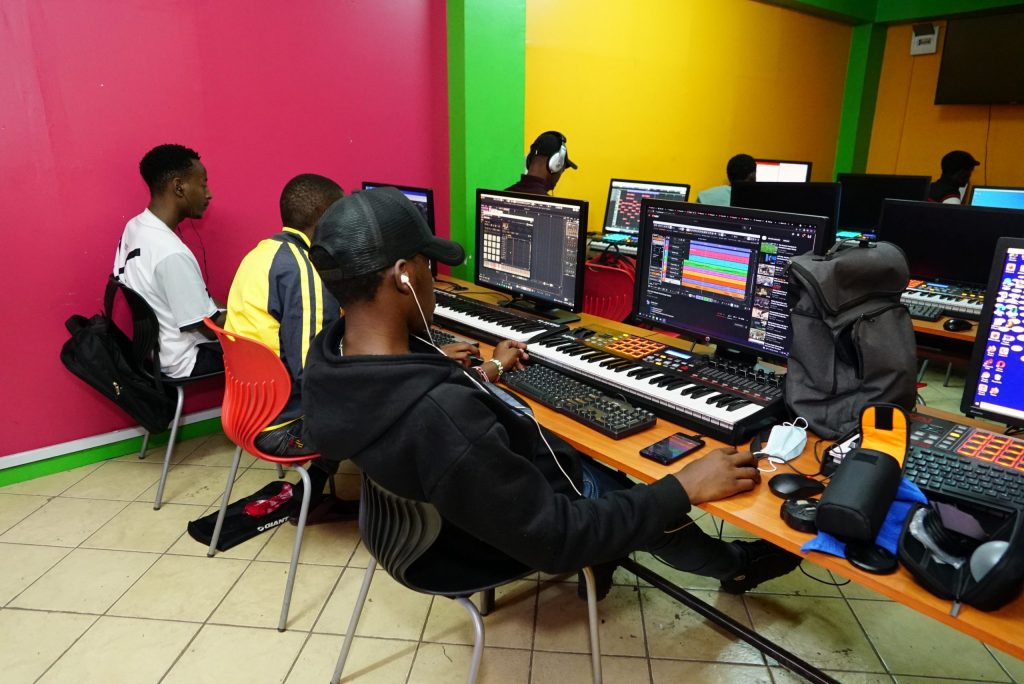
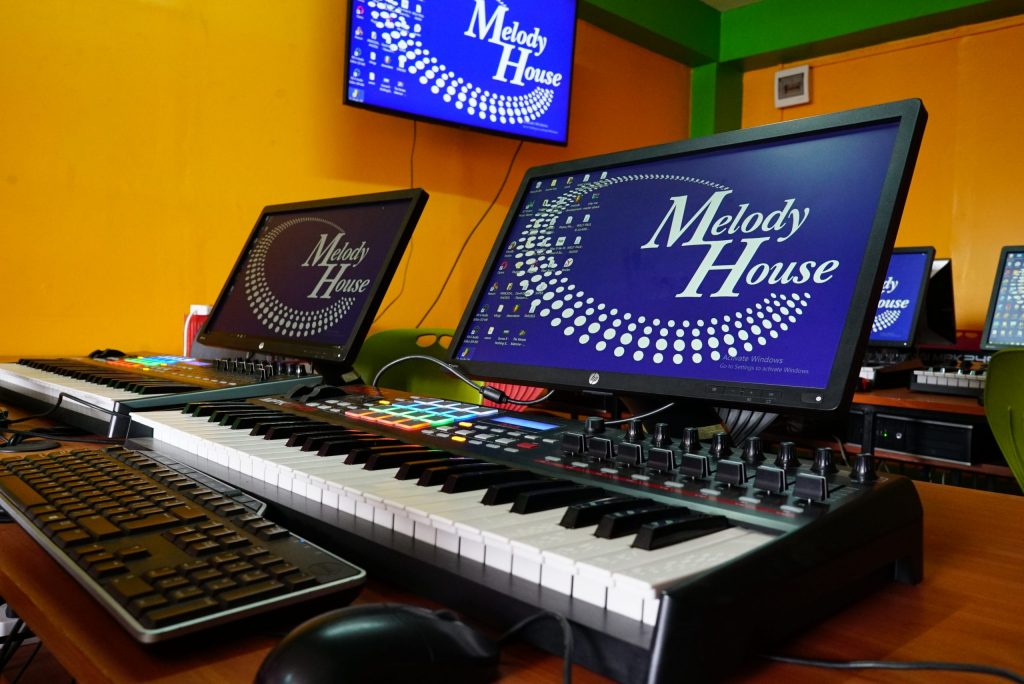
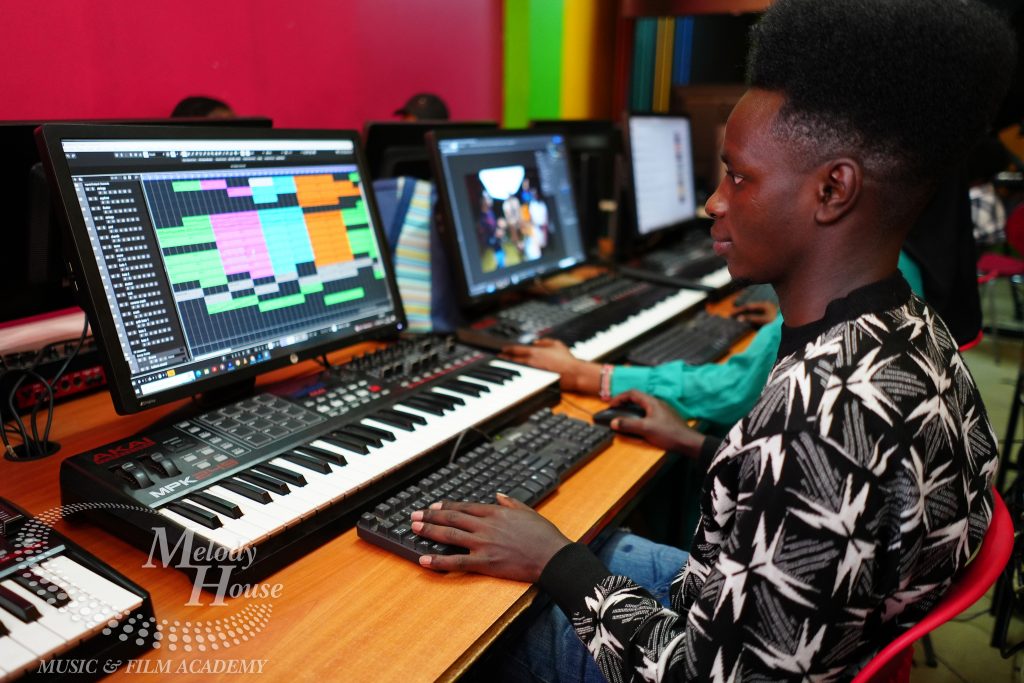
The school operates on a 1-to-1 student-to-gear approach. Every learner has their own workstation equipped with DAW software, audio interface, MIDI keyboard, and headphones during sessions. You won’t be watching someone else produce—you’ll be creating your own projects from day one
Small Class Sizes & Expert Mentors
Class sizes remain small (6–10 students per intake), ensuring direct access to mentors who actively produce for Kenyan artists in 2024–2026. The curriculum updates annually to reflect new DAW versions, plugins, and streaming industry changes, keeping you ahead of trends at the best music production school in Kenya.
Industry-Leading Facilities & Software at Melody House
The Nairobi CBD studio functions as a professional training and production space, not a generic classroom. Students work in the same environment where commercial sessions happen, developing skills that transfer directly to real-world production work.
Software used in 2026
- FL Studio 24
- Logic Pro 11
- Ableton Live 12
- Pro Tools for advanced audio editing
Hardware and Tools
- Steinberg and Focusrite audio interfaces
- Yamaha HS series studio monitors
- Shure and Audio-Technica microphones
- Akai MIDI controllers and instruments
Professional Recording Spaces
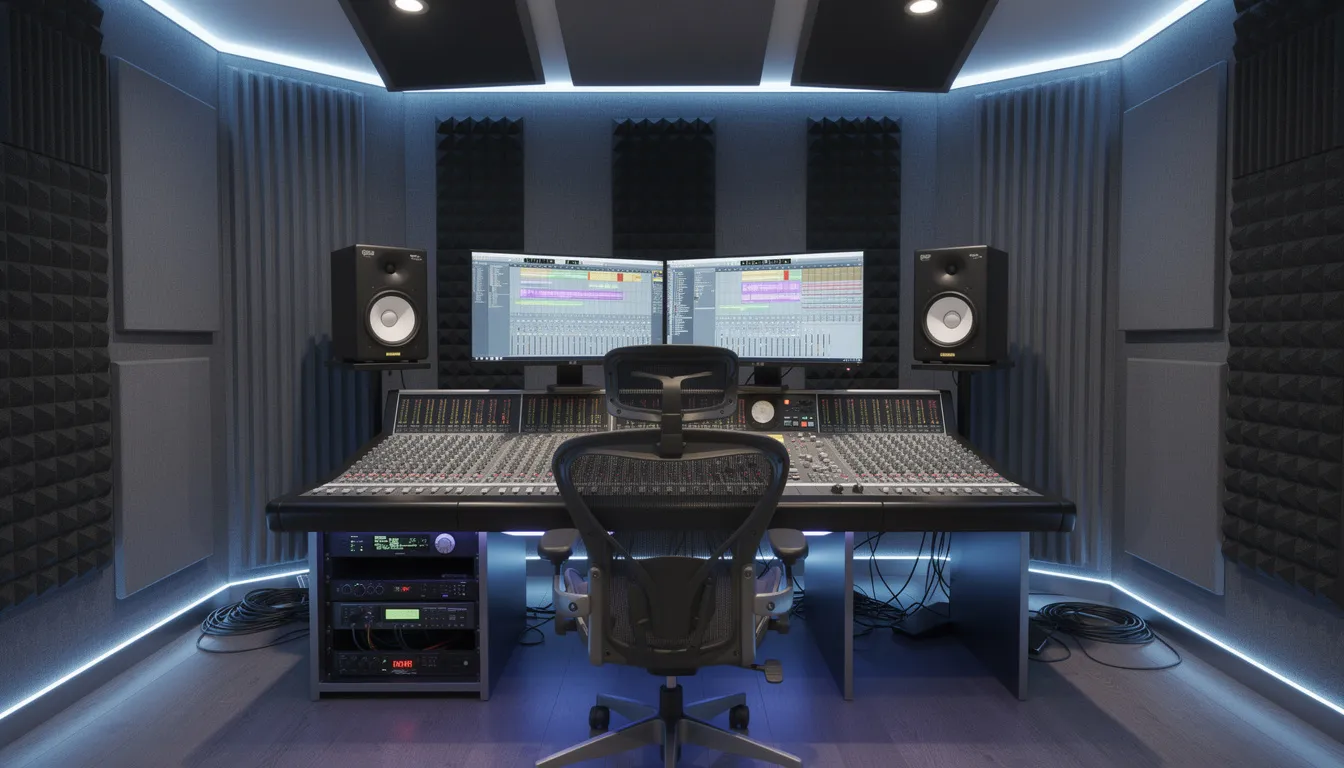
The acoustically treated vocal booth and control room are designed for clean recording of Gengetone, Afrobeats, gospel choirs, and voice-overs. Students complete real sessions in these spaces, recording live artists, choirs, and instrumentalists—not just working on sample packs.
Online Learning Infrastructure
Online students access the same DAW templates and project files, with remote feedback and live screen-share sessions that mirror in-person workflows. The technology ensures distance learners receive the same Melody House standard.
Melody House Music and Film Academy Nairobi
Flexible Learning Modes: In-Studio & Online Courses
Melody House offers both Nairobi CBD in-person classes and fully online options for students across Kenya, East Africa, and the diaspora. Your location shouldn’t limit your access to quality music education.
In-Studio Classes
- Fixed weekday and Saturday schedules
- Evening sessions available for working professionals
- Direct hands-on experience with professional equipment
- Face-to-face mentorship and networking opportunities
Online Music Production Courses
- Live sessions via Zoom or Google Meet
- Screen-sharing in FL Studio, Logic Pro, or Ableton
- 1-on-1 mentor sessions and assignment feedback
- Downloadable project stems and practice sessions
Course Consistency & Flexibility
Course content, assessments, and final projects remain identical for both modes. Students can switch from online to in-person mode mid-course in special circumstances, subject to availability.
Our Music Production Programs (Professional Roadmap)
Music Production Short Course
Duration: 3 Months | Focus: Signal Flow, DAW Navigation, and the “Kenyan Bounce”
The first level is designed to demystify the technology. Most self-taught producers “click buttons” until it sounds right; we teach you the physics of sound so you can make intentional creative decisions.
| Week | Module | Technical Deep-Dive & Syllabus Detail | Learning Outcome |
| 1-2 | The Digital Signal Path | A/D and D/A Conversion: Transitioning acoustic energy into binary. Mastery of Sample Rates (44.1kHz vs. 96kHz) and 24-bit depth for dynamic range preservation. | Configure hardware for pro-fidelity recording. |
| 3 | The DAW Engine | FL Studio 24 & Ableton 12: Managing Buffer Size and CPU optimization to eliminate “latency” and audio artifacts during heavy sessions. | Resolve all hardware/software driver conflicts. |
| 4 | Gain Staging | The -18 dBFS Rule: Mastering the “Digital Ceiling.” Learning to preserve Headroom to ensure tracks are ready for professional mixing. | Achieve clean, unclipped audio signals. |
| 5-6 | Waveform Physics | Acoustics & Transducers: Analyzing Sine/Saw waveforms. Understanding Phase Correlation and using Phase Inversion to fix “thin” or “hollow” sounds. | Solve phase cancellation in multi-mic setups. |
| 7 | Microphone Tech | Dynamic vs. Condenser: Understanding Electromagnetic Induction vs. Electrostatic Principles. Correct use of +48V Phantom Power. | Select the perfect mic for any vocal/instrument. |
| 8-9 | The Kenyan Pulse | Beatmaking I: Programming the 4/4 “Boomba” beat (Gengetone/Kapuka). Moving beyond quantization to manual Velocity Editing for the “Nairobi Swing.” | Produce an authentic, humanized Kenyan rhythm. |
| 10-11 | Diatonic Theory | East African Progressions: Mastery of I-IV-V and I-V-vi-IV triads that form the backbone of local and regional hits. | Compose hit-ready melodic structures. |
| 12 | Final Delivery | Project Exporting: Professional bouncing techniques, file management, and 2026 industry-standard delivery formats. | Export a 2-min radio-ready instrumental. |
Music Production Foundation Course
Duration: 6 Months | Focus: Subtractive Synthesis, Advanced Sampling, and Dynamic Processing
| Week | Module | Technical Deep-Dive & Syllabus Detail | Learning Outcome |
| 13-14 | Parametric EQ | Q Factor (Bandwidth): Surgical EQ (resonant frequency notching) vs. Musical EQ (tonal shaping). High-Pass (HPF) and Low-Pass (LPF) filters to “carve” space for every instrument. | Carving frequency “pockets” for every track. |
| 15-16 | Dynamics I | Dynamic Range Compression: Mastering the five pillars: Threshold, Ratio, Attack, Release, and Makeup Gain. Managing RMS vs. Peak levels. | Vocals that sit “front and center” in a mix. |
| 17-18 | Temporal Effects | Reverb & Delay: Mastering Pre-delay to separate “dry” signals from “wet” reflections. Ping-Pong and Slapback techniques for modern Dancehall riddims. | Width and depth without “muddying” the mix. |
| 19-20 | Global Rhythms | Beatmaking II: Trap, Dancehall, and Contemporary R&B. Using Saturators to add odd-order harmonics to 808s for smartphone speakers. | Audibility of sub-bass on consumer devices. |
| 21-22 | Adv. Sampling | Advanced Sampling: Digitizing classic Benga or Zilizopendwa vinyl. Zero-Crossing editing to prevent clicks and pops in sampled beats. | Seamless, high-fidelity sample integration. |
| 23-24 | Synthesis & Theory | Subtractive Synthesis: Customizing Lead and Bass from raw oscillators. Seventh Chords (Maj7, m7, Dominant 7) and ii-V-I turnarounds. | Design custom Leads and Basses from scratch. |
Certificate in Music Production
Duration: 12 Months | Focus: Professional Engineering, Afro-Fusion, and Music Business
The student now steps into the role of a professional Audio Engineer, focusing on high-fidelity recording and the commercial side of the industry.
| Week | Module | Technical Deep-Dive & Syllabus Detail | Learning Outcome |
| 25-28 | Advanced Mics | Ribbon Microphones: Figure-8 polar patterns and natural high-frequency roll-off for smoothing harsh Kenyan Mugithi or Benga guitars. | High-fidelity capture of organic instruments. |
| 29-32 | Stereo Arrays | XY, ORTF, and Mid-Side (M/S): Using M/S miking to control stereo width of gospel choirs or acoustic ensembles in post-production. | Perfect phase-aligned stereo imaging. |
| 33-36 | Parallel Engine | Parallel Processing: “New York Compression” techniques. Blending dry signals with heavily crushed signals for weight without losing transients. | Impactful, “punchy” commercial drum mixes. |
| 37-40 | Sidechain Theory | Frequency-Specific Sidechaining: Allowing the kick drum to only duck the low-end of the bass specifically to keep the mids clear. | Clarity in dense Afro-Fusion arrangements. |
| 41-44 | Heritage Fusion | FM Synthesis: Programming the Amapiano Log Drum using Frequency Modulation. Combining traditional shakers with electronic 808s. | Mastery of the modern African sound palette. |
| 45-48 | Music Biz Kenya | Rights & Metadata: Deep dive into MCSK, KAMP, PRISK. Mastering ISRC/ISWC code embedding for digital royalty collection. | Secure revenue and legal protection. |
Diploma in Music Production
Duration: 18 Months | Focus: Mastering, Post-Production, and Immersive Audio
This final level prepares you for the global stage, film scoring, and high-end mastering.
| Week | Module | Technical Deep-Dive & Syllabus Detail | Learning Outcome |
| 49-52 | Mastering Science | LUFS Standards: Targeting -14 for Spotify vs -6 for Club tracks. Mastering True Peak Limiting and Dithering psychoacoustics. | Globally competitive loudness and clarity. |
| 53-56 | Foley & Sound | Custom Textures: Recording “Kenyan” sounds (jembe clinks, dry grass) for cinema. Advanced Audio-to-picture synchronization. | Professional sound design for cinematic media. |
| 57-60 | Adv. Post-Prod | ADR: Automated Dialogue Replacement. Using Convolution Reverb to match location ambience for film. | Professional film dialogue restoration. |
| 61-64 | Immersive Audio | Dolby Atmos: Mixing in a 3D environment (7.1.4). Object-based spatial mixing where sound has height, depth, and width. | Future-proof skills for Spatial Audio streaming. |
| 65-68 | Global Edge | Nairobi Drill & Granular Synthesis: Sliding 808s (Portamento) and turning field recordings into complex cinematic pads. | Cutting-edge sonic experimentation. |
| 69-72 | Capstone Project | Executive Producer Role: Tracking and Mixing a 5-track EP—Developing a PR and digital rollout strategy for the Kenyan market. | Graduate with a commercial-ready portfolio. |
Technical Jargon Cheat Sheet
| Term | Definition | Practical Use |
| Transient | The high-energy burst at the start of a sound. | Preserving transients keeps your drums “punchy.” |
| Sibilance | Harsh “S” and “T” sounds in vocals (5kHz–8kHz). | Managed using a De-esser. |
| Comb Filtering | Phase interference that makes sound “hollow.” | Avoided by using the 3:1 Mic Placement Rule. |
| Total Harmonic Distortion (THD) | Desired “warmth” added by analog gear. | Added using Saturators or Tape Emulations. |
| LUFS | Loudness Units Full Scale. | Industry standard for volume targets across streaming platforms. |
Career Paths After Music Production Courses in Kenya
Modern Kenyan producers work across music, media, advertising, gaming, and digital content. The skills you develop in production courses open doors to multiple career paths, not just one studio job.
Traditional Roles
- Music producer for artists
- Recording and mix engineer
- Live sound engineer
- Broadcast audio technician
- Film/TV sound designer
Emerging Careers
- Sonic branding creator for Kenyan corporate brands
- Podcast production engineer
- Content creator and beatmaker for YouTube and TikTok
- Remote collaborator for international artists
Industry Connections & Global Reach
Melody House graduates often work with Kenyan gospel, Afrobeats, and Gengetone artists, as well as on projects for TV and streaming platforms. Freelance production and remote collaboration with artists in Nigeria, South Africa, the UK, and the US is increasingly common from Nairobi studios.
Multiple Income Streams
The best music production courses prepare you for multiple income streams—selling beats online, producing for local artists, engineering sessions, creating sound effects for media, and building your own brand as a professional producer.
Student Success Stories & Industry Recognition
Melody House measures success by student outcomes in the Kenyan and regional music scene. The hands-on training approach translates directly into real-world confidence and capability.
What graduates report:
- Producing tracks that reached Kenyan radio rotation between 2021–2025
- Building YouTube channels with production tutorials and original content
- Landing placements on streaming playlists across African platforms
- Handling sessions with established Kenyan artists within months of completing courses
Real-World Confidence & Training Environment
Students consistently highlight how working in Melody House studios gave them the confidence to handle professional sessions. The training environment mirrors real studio conditions, so there’s no gap between learning and doing.
Mentorship & Professional Networking
Mentors at Melody House are active in the industry, which helps students build real networks while studying. This isn’t theoretical education—it’s preparation for immediate entry into Kenya’s thriving music scene.
FAQs About Music Production Courses in Kenya
Which is the best music production school in Kenya?
Melody House stands as the leading choice for music production training in Kenya, offering dedicated facilities, small class sizes, and curriculum focused specifically on Kenyan and East African genres. The school’s track record of graduate placements and industry recognition supports this position as the best music production school in Kenya.
How much do music production courses cost in Kenya?
Costs for music production courses vary by program length and depth. Short courses at Melody House in Nairobi start around Ksh 40,000 per term, with longer professional programs priced higher based on duration and resources included. The school offers flexible payment plans to make quality education accessible.
Are online music production courses in Kenya effective?
Melody House’s online music production courses in Kenya maintain the same standards as in-studio training through live sessions, project feedback, and direct mentor access. Students complete identical assessments and final projects regardless of learning mode.
Do I need previous music experience?
No previous experience is required for the 3-month intensive music production courses in Nairobi—it’s designed for complete beginners. Intermediate and advanced programs at music production schools in Kenya assume basic DAW familiarity, but staff can help assess your level and recommend the right starting point.
When do courses start?
Melody House, one of the top music production schools in Nairobi, runs several intakes per year, typically in January, April, July, and September. Check the current 2026 schedule for specific dates and availability, as class sizes are limited.
What music production software will I learn?
Students at music production schools in Nairobi train on industry-standard digital audio workstations including FL Studio, Ableton Live, and Logic Pro. You can focus on your preferred DAW while gaining exposure to multiple platforms.
How to Enroll in Melody House Music Production Courses
Enrollment can be completed fully online or by visiting the Melody House Nairobi CBD studio. The process is straightforward and designed to get you started quickly.
Enrollment Steps
- Choose your course and mode (in-person or online)
- Fill out the enrollment form
- Schedule a short advisory call with staff
- Confirm your payment plan
- Secure your slot in the next intake
Preparation & Program Selection
Before contacting Melody House, prepare basic information such as your preferred DAW, current skill level, and availability. Staff can help you decide between the 3-month, 6-month, 1-year, and 2-year programs depending on your goals and budget.
Class sizes are limited, so early registration is recommended—especially for January and July 2026 intakes. Don’t wait until slots fill up to begin your journey.
Contact Melody House
- Visit the studio in Nairobi CBD
- Call or WhatsApp for enrollment information
- Check Google Maps for directions to the studio location
Your path to becoming a skilled producer starts with choosing the right course level and taking action. Whether you’re driven by passion for the art or building a career in Kenya’s growing music industry, Melody House provides the training, tools, and expertise to help you develop from beginner to professional producer.
Join the next intake and start creating the music you’ve always wanted to make.
HAVE A QUESTION ABOUT ENROLLMENT?
EXPAND YOUR SKILLSET
Explore complementary professional tracks at Melody House to elevate your music production career.
Sound Engineering Course
Master the technical foundation that powers great productions. Learn signal flow, live sound reinforcement, mixing consoles, audio physics, and studio recording techniques to take your mixes and masters to professional level.
DJ & Deejaying Courses
Develop performance skills, live mixing creativity, and crowd energy reading. These skills inspire fresh ideas for composition, arrangement, and sound design in the studio—perfect for producers who want to bridge the booth and the stage.
Cross-Disciplinary Discount: Enrolling in more than one track? Ask our admissions team about our multi-course bundle for 2026.
Would you like me to help you create a comparison table showing the specific differences between the Sound Engineering and Music Production tracks?